
An overview of the book of Revelation
Revelation is quite different from other books in the Bible and subject to contradictory interpretations. Even though Christians appreciate this book for the hope it inspires and the grandeur of its scope, there is considerable disagreement on how to make sense of its riddles.
With this word of caution to not lightly dismiss alternative interpretations, a survey in three parts here attempts to trace how the author himself understood these visions. To identify the signposts from the author, it is necessary to recognize when Revelation borrows images from elsewhere in the Old or the New Testaments: Their meaning in the context from which they are taken is the only key available to unlock the riddles of the book of Revelation. Therefore, a short series of introductory studies explored some of these key topics in advance.
The next aim of this study is to obtain a birds eye view of how the book of Revelation is structured as a so-called chiasm, because this classic literary style was commonly known in antiquity to provide the readers with important clues what the author meant and how different parts of his book are designed to explain each other. To some, this may provide a fresh perspective on what they have found before. Others may inevitably feel challenged in their tradition. Either way, any conversation about the book itself and where it points us to look for its interpretation must serve the purpose to “keep what is written in it”, Rev 1:3; 22:7.
Warm-up: What is your first emotion when you hear the book of Revelation mentioned?
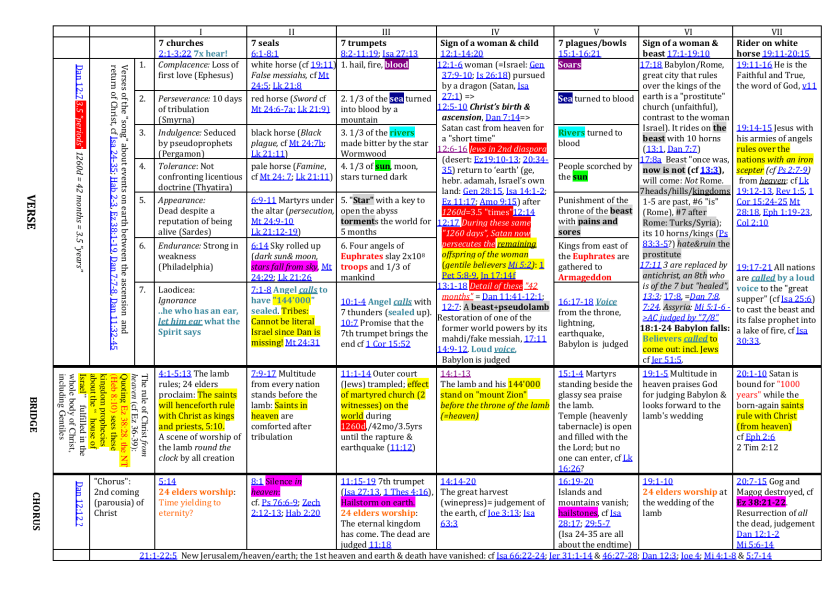
Aim: Survey the overall structure of this book. Does it consist of a description of one long chain of future events in chronological order from A to Z, or does it actually repeat itself, like a song with multiple verses about one and the same subject?
1) A summary in the attached table shows that the book of Revelation is organized as a total of 7 stanzas (numbered I to VII). They all adhere to a similar structure.
- What theme is repeated each time like the ‘chorus’ of a song, e.g. in Rev 16:19-20 ? => In multiple Old Testament passages, the prediction of ‘hailstones’ announced a future judgment from God: What judgment? cf Ez 38:21-22; Isa 28:17 and 29:5-7 =>
- Since hailstones were a common metaphor for the end of time already in the Old Testament, what do you expect them to signify in the book of Revelation?
- In Rev 14:14-20, the end of the world is described by yet another metaphor. Which one?
- How many times does Revelation describe the end of the world with these or other OT metaphors? =>
- If all seven choruses are visions of the same final judgment, what must the silence in heaven (Rev 8:1) signify?
- Read Ps 76:6-10; Zech 2:12-13 and Hab 2:20-24, => Who is silenced and how? Why is this silencing a good thing? Hint: The context in Habakuk (chapters 2-3) is about the destruction of Antichrist at the end of times.
- Three of the 7 choruses use the image of 24 elders laying down their crowns (Rev 5:14; 11:16; 19:4): If also these choruses are about the end of time as we know it, how does the number 24 convey this? [Note: If the number 24 were not explained by this context, its meaning is bound to remain mere speculation]
2) Remember the dreams of the pharaoh of Egypt in the days of Moses: What were they about, and what did Joseph highlight as the clue which led him to rightly interpret them? cf Gen 41:25 =>
- Joseph recognized that the two dreams of cows and of corn were not two dreams, but rather one and the same; not about different events, but rather two visions of one and the same event: How could he know? =>
- Read Gen 37:5,9. How many dreams came to Joseph himself as a boy? Were they about two separate subjects, or about one and the same?
- What is the effect if God reveals the same thing again but with another dream? cf Heb 6:17-18
3) The chart of how the book of Revelation is organized shows that both stanzas III and V (flanking the central stanza IV in the middle of the symmetric number 7) use similar images in exactly the same order. What purpose does that serve?
-
- Did John predict history to repeat itself? Or did he describe (i.e in two dreams) the same future period twice, to confirm how certainly this era must unfold?
- Do any other stanzas share common elements indicating that they too speak of one and the same time period?
- e.g.: A calling, and a loud voice, and an angelic command to hear: Do they all feature in each of the stanzas I-VII?
4) If Revelation thus describes the end of the world no less than seven times, what is the era between those descriptions? => Do any of the 7 stanzas state how long this “end-time” period must last?
- 1260 days = 42 months (3.5 years) = “a time and times and half a time”, cf Rev 11:1-14, (stanza III) and Rev 12:6&14 (stanza IV): This number of 3.5 ‘years’ alludes to the second half of the 70th “week” mentioned in Dan 9:27. This verse has been interpreted to refer either to a “covenant” by antichrist (that is never mentioned anywhere else in the Bible, though), or to the (New) Covenant established by Messiah that is the main theme of the whole Bible, v26: Which one is it according to the book of Revelation?
- Rev 12:6 counts from the beginning of the second diaspora of the Jews until its end when the ‘earth’ (i.e. their land, cf e.g. Gen 28:15, Isa 14:1-2; Ez 11:17; Amo 9:15) comes to their aid. This corresponds to the time when the “outer temple court” of Rev 11:1-2 is trampled, confirming that both texts mean the fate of Judaism. It also confirms that the 2 witnesses of Rev 11 cannot be literally 2 people, but instead represent the entire body of believers (as discussed in the preceding studies Rev-Intro-1 and Rev-Intro-2).
- Is there a way to further test the hypothesis whether this duration of 1260 days is a metaphor for all of church history? =>
5) This brings us to the mystery of the interludes, or “bridge” passages (indicated in the right-most column of Table 1 for each of the 7 stanzas I to VII): What are they about?
- In these bridges, the repetitiveness is not self-evident or as explicit as in the ‘stanzas’. Instead, the key to their explanation – namely that they too sing 7 times of the same truth – can only be inferred from the 7-fold structure of the stanzas and their ‘choruses’. Accordingly, these bridge passages are intended to mutually explain each other and their actual meaning => study next time!
6) Application
- If tomorrow you decided to start reading Revelation, what do you expect to get out of it?
- How should we go about reading it? Commentary? Internet sermons? One verse at a time? Bird’s eye view?
 Bibletogetherblog