
Ezekiel’s vision of the temple

Questions below are from a mini series of studies on Old Testament prophecies mentioned in the book of Revelation in the New Testament. Their aim is to first become familiar with those visions in their original context and then discern what the book of Revelation added to them in the New Testament, and why.
Background for leader: Ezekiel, son of Buzi [Ezk 1:3], a priest of the Kohen (Kohanim) lineage of the patrilineal line of Ithamar, was exiled in 599 (or 597) by Nebuchadnezzar after the first conquest of Jerusalem. He prophesied the destruction of Jerusalem and the restoration to the land of Israel.
The timing of Ezekiel’s vision is significant: After the Babylonians sacked Jerusalem and destroyed its temple in their attempt to stamp out Judaism, many concluded that this was the end of the story. Instead, God reassured his people through Ezekiel that the spiritual temple of which the building in Jerusalem was only an image is an unceasing spiritual reality. It will never cease to be the source of ‘freshwater’ to the nations. However, Ezekiel’s vision announced that in his days a new distinction was introduced as to who can enter this temple to worship, and who cannot.
As Ezk 40-47 is by design a riddle that is not trivial to interpret, it would not be prudent to make these chapters a cornerstone for any eschatological system. Texts where the meaning is plain should be used to interpret those where the literary style or the content are by design a riddle. Doing it the other way round is a recipe to read into the Bible what is not there. For example, a Wikipedia article describes Ezk 40-47 as the Millennial Temple visions about a “Third Temple”, even though Ezekiel nowhere mentioned any earlier “second” temple, or a “millennium”. Nowhere does his vision contain any instructions to build a temple, let alone to do so in the future. Instead, it describes a ‘temple’ in full swing. The readers are not asked to expect or implement a change in the layout of a literal future building, but to observe the design of the true temple that never did and never will cease to exist, and what that design means.
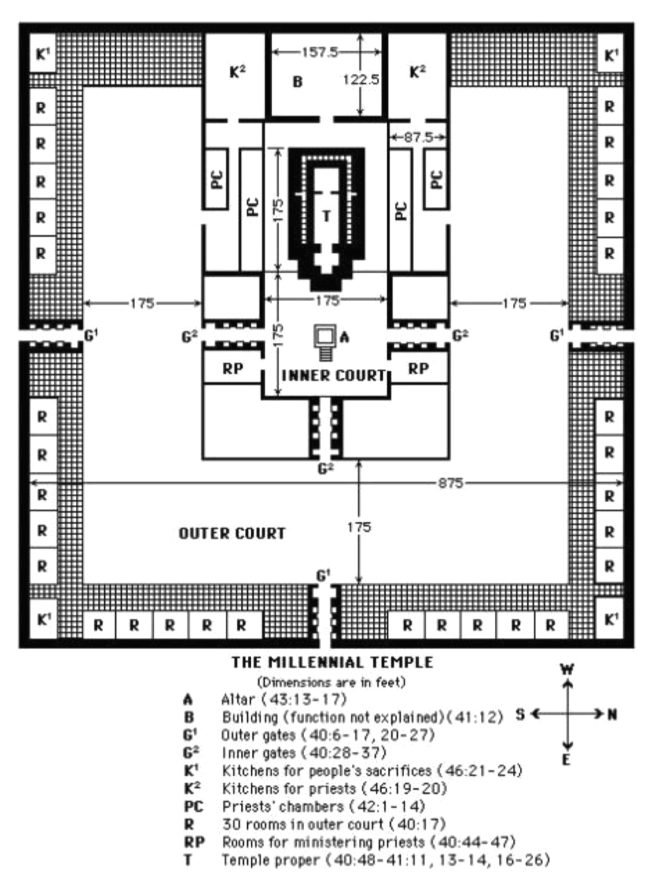
Concerning the meaning of this design, Ezekiel’s own emphasis (Ezk 40:46; 43:19; 44:15; 48:11) and the New Testament agree that a new distinction between two kinds of priests with different duties in the inner versus outer ‘temple courts’ is the key point. Indeed, a related but even more drastic change was introduced by the book of Revelation after Jerusalem had been sacked again in 70 AD: Since then, the outer district is no longer counted as part of God’s house the way Ezekiel had been told to measure. Instead, it will be “trampled by the nations” (Rev 11:2). Thus, Ezekiel and the NT agree what the division of God’s house and its priests into inner and outer districts signifies, and that no one can enter this house and worship, except by following its rightful owner. The difference introduced in Revelation is that only now, the outer district which Ezekiel assigned to the priests who parted from this rightful heir is no longer counted to be part of God’s dwelling place. This tragic judgement will not last forever, though, but only for a limited duration of “42 months” (Rev 11:2). How the book of Revelation explains the meaning of this duration is a question for a later discussion*.
1) Title and purpose of the vision: Does your Bible add subtitles to Ezk 40-47? If so, what do they suggest what these chapters are about?
- Read Ezk 40:1-5. Did Ezekiel claim anywhere that this is a new temple?
- v2: Why didn’t the Israelites adopt this layout (hebr. mibneh, lit. frame, structure) when they reconstructed Jerusalem and its temple after the Babylonian exile? If they didn’t interpret v2 as a directive for architects, why should anyone?
- Read Ezk 47:1-9. In his vision, Ezekiel saw a ‘river’ flowing from this ‘temple’:
- A priori, does this sound like a metaphor, or like a literal river?
- Does he indicate at what time this water flows? [v1: Present tense].
- What do freshwater and the sea symbolize in the Bible as metaphors? cf e.g. Isa 44:1-5; Isa 17:12; Jn 4:22-26 [Freshwater (life-giving Spirit) flowing from the earth (Israel) into the sea (nations)] => At what time(s) was that supposed to happen? Only in a distant future? Why not?
2) Read Ez 43:10-11. What was revealed to Ezekiel himself about the purpose of his vision? v11b: “…that they may be ashamed…”: Who, and of what?
- What sins do chapters 40-47 expose? => Read Ez 44:10+15 => Who were those “Levites who went far from me”? => Who was Zadok?
- Read 1 Ki 1:5-10, and 22-35: Abiathar (like Ezekiel himself from the line of Ithamar) sided with the self-appointed king Adonijah to support him instead of Solomon as David’s successor. Only Zadok remained faithful to David and to the rightful heir of David’s throne =>
- How does this story of Zadok and Abiathar define what was the sin of unbelieving Israel?
- “…when the people of Israel went astray from me” (Ezk 44:15): How did Abiathar’s betrayal of David’s rightful heir become an apt metaphor for how Israel strayed from the true Son of David in Ezekiel’s time? How did they turn from Messiah? cf Ezk 20:6-8, 13, 21
- What consequence did the metaphor of this vision predict for those who emptied their religion by turning from God’s anointed Prince? Ezk 44:15 =>Being excluded from the feast of the Prince in the inner court, what became their new task? [see also below]
3) “…so that they may be faithful to its design…”, v11b: What did Ezekiel’s vision highlight about the temple design, and why?
- “…so that they may be faithful to its design and follow all its regulations“. Consider first the design (s. plan above): Why two walls, an outer and an inner one? Why any walls at all, and why not just one? => Hint:
- Ezk 40:3-5. What parts of the temple did the man in Ezekiel’s vision measure, and what did such measuring signify? v5 [Despite the Babylonian exile during the days of Ezekiel, all Israel was still counted as God’s holy people] =>
- Read 44:1-5. “..Give attention to the entrance of the temple…“: What are the readers meant to discern about this entrance? Who is shut out? Ezk 44:9 => What is an “uncircumcised heart“? cf Phil 3:3
- While all buildings and their purpose are described in minute detail, how about building B? What do we learn about it? What could it mean that B is behind but bigger than the temple (T) that was reserved for sacrifices by the Levitic highpriest?
- Why raise such expectation for something greater to come? cf Heb 9:11 Does Ezekiel draw attention to decorations, or rather to who will be shut out after the coming of the Prince?
- In Rev 11:1, the NT revisits the theme of measuring God’s temple: What is no longer measured now? [“...measure the temple itself and the altar, but not the outer court“] There, the outer court is no longer counted as part of the ‘temple itself’. Why not?
4) “…so that they follow all its regulations” (43:11b): What did Ezekiel’s vision change in the existing rule about who can access which parts of the temple ?
- Read Zech 3:7 => After the return from the Babylonian exile, a high priest named Jeshua oversaw again the ministries in both the inner and the outer courts of the temple that had been re-built. By contrast, the metaphorical “temple” in Ezekiel’s vision introduced a distinction between two classes of priests: Which ones? =>
- Read Ezk 44:11-16: What became the duties of those Levites who followed the usurper of David’s throne ?
- vv11&14: Appointed to still oversee (only) the outer temple court, as guards to keep people away (!) from the sanctuary,
- vv12-13a: but without access to God because they were condemned to instead bear now by themselves the shame and punishment for their sins. How?
- Ezekiel saw that priests who don’t believe and trust in Messiah still existed, and he wrote that even though they were still counted to belong to God’s house, they were only fit as guardians to also keep away all others who are equally uncircumcised of heart. How does this look in the practice of religion? cf Lk 11:52
- By contrast, what ministries were assigned to Zadok’s “descendants”?
- v15: “They enter the sanctuary to stand before God”. How?**
- v23: They teach God’s people about this difference in religion; they keep the law and its ‘Sabbath’ (i.e. resting from our own works by trusting in the work of Christ, cf Heb 4).
- Accordingly, what does it mean to be “faithful to the design of this temple”, Ezk 40:1-4? ***
5) Application
- Do you think the temple visions of Ezekiel and in the book of Revelation call for a literal temple in an earthly millennial kingdom? Why or why not?
- Jesus fulfilled in reality what animal sacrifices could only foreshadow, Heb 8:5-13. Did Ezekiel foresee that priests in a literal earthly temple will have to reinstall animal sacrifices even though these already became totally obsolete ? Why not?
- Ezekiel’s vision predicted the destiny of Jews of his own time, i.e. that a faithful remnant among them will be set aside from this nation by God himself. This is history. Does this vision say anything about Jews in a future millennial kingdom?
- Ez 20:34-38 makes the same distinction of a remnant, i.e. that only few of those who returned to Israel after their exile in Babylon will believe Christ; the majority will remain under God’s wrath for their rebellion, like their forefathers in the desert under Moses. Do you think it matters at all to understand this even today? Why or why not?
- What do you think could be God’s purpose with the nation of Israel for our world today, and of world events that put this tiny country into news headlines all over the world almost every day?
- By birth, Ezekiel was a Levite too, but not of the line of Zadok. What did this mean for him personally when he charged his peers that their fate was the price for abandoning the rightful heir of David? How does this experience compare to your own as a Christian?
* 3.5 years/42 months/1260 days is how Rev 11-12 describes the time of the second diaspora (to examine those symbols, see the studies on Two Witnesses and The Woman with Child)
** The priests of the outer district and those of the line of Zadok were seen by Ezekiel to live in two separate three-story buildings. One north and the other south of the sanctuary, each facing the outer court and being accessible from there on the ground floor (42:8-12). However, only the line of Zadok can enter the inner court to eat there in two chambers adjacent to the northern gate and to serve at the altar and in the temple behind it (42:13-14). Note that such faith therefore defined true worship already before Jesus was born, and that it was not limited to priests from the literal tribe of Levi (see e.g. Lk 1:67ff; 2:25ff; 2:36ff).
*** Already since the beginning, the literal temple in Jerusalem was only a symbol of the true spiritual house of God in the body of Christ. The point of Ezekiel’s vision was to reveal what it takes to be a priesthood who ‘eats from the altar’ and who thus are enabled to teach others about it properly. Knowing, discerning and teaching what distinguishes this faithful priesthood from unfaithful priests who only keep others away from the kingdom of God became mandatory, at least since the time of Ezekiel, 43:11b.
 Bibletogetherblog